About us
A platform that gives the city back to the people who live it
MINOMO is not another deals app, nor yet another business directory. It is a digital proximity infrastructure: the nervous system that lets a city talk to itself without asking an algorithm for permission.
- 0% Algorithm tax Nobody pays to be seen
- 5sec Onboarding One QR code, you're in
- 100% Local data Never sold, never to third parties
- 3 Native languages Italian, English, Romanian
Why we exist
If you have to pay to be seen by your own city, it's not marketing anymore. It's rent.
For fifteen years global platforms have rented out the voice of your city. They decided who sees what, they taxed visibility, they sliced the local community into audience pools sold to the highest bidder.
The result is plain to see. A shop pays to talk to customers who live 50 metres away. A professional never surfaces for the person searching for them right now. A municipality launches an app nobody downloads. A citizen finds out the corner café has closed only when they walk past the lowered shutter.
MINOMO exists to take back the square. Not out of nostalgia for an analogue past, but with technology designed from scratch to serve the territory, not sit above it.
What we won't compromise on
-
We don't sell your data
Neither of those who publish nor of citizens. Ever. It is a structural decision: our business model does not depend on selling it, and never will.
-
No opaque algorithm between you and your audience
When a notification goes out to your followers, it reaches all of them. Full stop. There is no delivery system deciding who deserves to see it in exchange for a paid upgrade.
-
Geo-lock: value exists only in presence
You can't 'discover' the city from the sofa. MINOMO's offers, content and experiences are anchored to the physical territory. You're there, or you don't see them.
-
The City Agent is a person, not an icon
Every territory has a human curator who knows the streets, the venues, the stories. We don't replace them with an AI — we amplify them with the right tools.
-
Verifiable source code where it counts
The components critical to privacy and security are open or inspectable. We don't ask for trust: we give you a way to check.
Atlas, in production
An editorial directory for every city MINOMO calls home
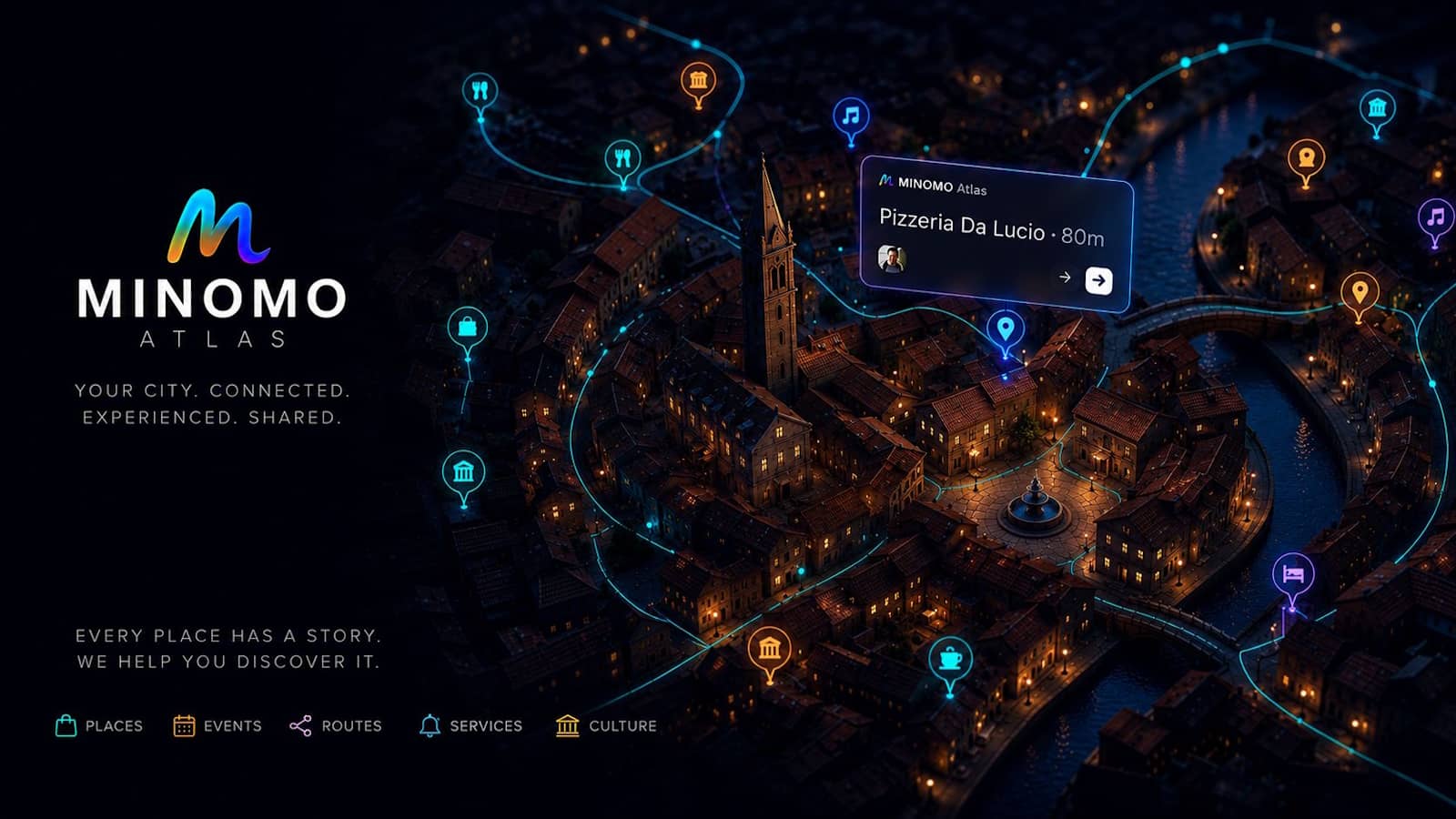
MINOMO Atlas collects a city's venues, events and itineraries into a public, indexable page, optimised for Google and for AI search engines. Free for every business, independent of whether that business has joined the platform.
Explore AtlasThe long read
A story in three acts
It all started in 2021 with a banal question: why do local directories fail? We had built (and partly failed at) the N+1 version of a “virtual city guide”, like hundreds of others before and after us. The answer wasn’t in the data or the technology: it was in the mental model.
Directories assume the problem is inventory — knowing what’s out there. But the real problem is access — knowing what you need, when you need it, where you need it. A pizzeria doesn’t need to appear in a list; it needs to be able to tell the 200 neighbours nearby that tonight at 7 it has just pulled its gourmet focaccias out of the oven and they’ll be gone within the hour.
Between 2022 and 2024 we rebuilt the product twice. We looked at what actually worked — not in founder slides, but in real life: who came back to the app after three months, and why. The answer was always the same: the people who had received a useful notification, from someone they trusted, at a contextual moment.
The 2025 pivot
In 2025 we made a decision many advisers warned us against: stop calling ourselves a “guide” and start calling ourselves infrastructure. It’s a deeper change than a marketing pose. A guide is a consumed product — you use it or you don’t. An infrastructure is a network other actors rely on, and it works better the more it is used.
From that moment, every product decision was filtered through one question: does this help the network work, or does it just sell more features?
Everything that fell into the second category was removed.
What we are building, concretely
Four pieces that hold together:
- The citizen app — a PWA plus native iPhone/Android apps. Geo-locked, no algorithmic feed, a direct conversation with whoever you choose to follow.
- The publisher panel — communication tools (notifications, bio page, Atlas profile), customer management, digital loyalty cards. All free of the “algorithm tax”.
- The City Agent — a real person, on the ground, who curates the catalogue of venues and supports the first campaigns. Not a chatbot. Not a remote BDR.
- MINOMO Atlas — the editorial directory optimised for Google and AI search engines, free for every business, independent of whether that business has joined the platform.
They are different pieces, moving at different speeds. But they all answer the same logic: giving back a direct communication channel between those who live the city and those who keep it alive every day.
Questions from the public
-
Who is behind MINOMO?
AVi Kairos Srl, a Romanian company based in Brașov. The infrastructure is designed, developed and continuously updated by a team of full-stack developers, while communications and marketing are led by entrepreneur Aura Anghel. MINOMO's distribution is handled by local Country Managers, in collaboration with public institutions.
-
How do you make money if you don't sell data or show ads?
We sell real utility, not visibility. Businesses, professionals and creators only pay for optional add-ons (sending push messages to their own followers, city-wide broadcasting, digital loyalty cards). Citizens pay nothing. Municipalities that adopt MINOMO Atlas as official infrastructure pay per use for citizen notifications, and only once certain thresholds are exceeded.
-
Why do I still have doubts about privacy?
That's legitimate. Platforms have abused the word 'privacy' for too long. Our technical architecture is described on /en/legal/privacy/ and /en/legal/cookies/, with references to the real systems (who, where, for how long, with which encryption keys). No marketing speak: just specs.
-
Does it work outside Italy and Romania?
MINOMO works everywhere, but we've chosen to structure and activate one country at a time. It will soon be available in other countries too. Today the platform speaks Italian and Romanian, with English as a fallback language; more languages are coming soon.
In chiusura
MINOMO is a pact between those who work, those who create, City Agents, citizens and administrations. You enter freely, you leave freely.