There is a peculiar silence in restaurants that boast thousands of Instagram followers. A silence that does not stem from a lack of popularity, but from a technological rupture. The owner has spent years building their audience, posted impeccable photographs, created generous offers — only to discover, with cold frustration, that their message reaches fewer than 5% of their own followers.
To be seen by people two blocks away, they must pay a toll to a “digital customs officer” situated thousands of kilometres away. The paradox of the modern internet is that it has connected us with the entire planet while making direct communication with the person next door almost impossible. The city has become a collection of digital silos, isolated by algorithms that decide who is entitled to visibility.
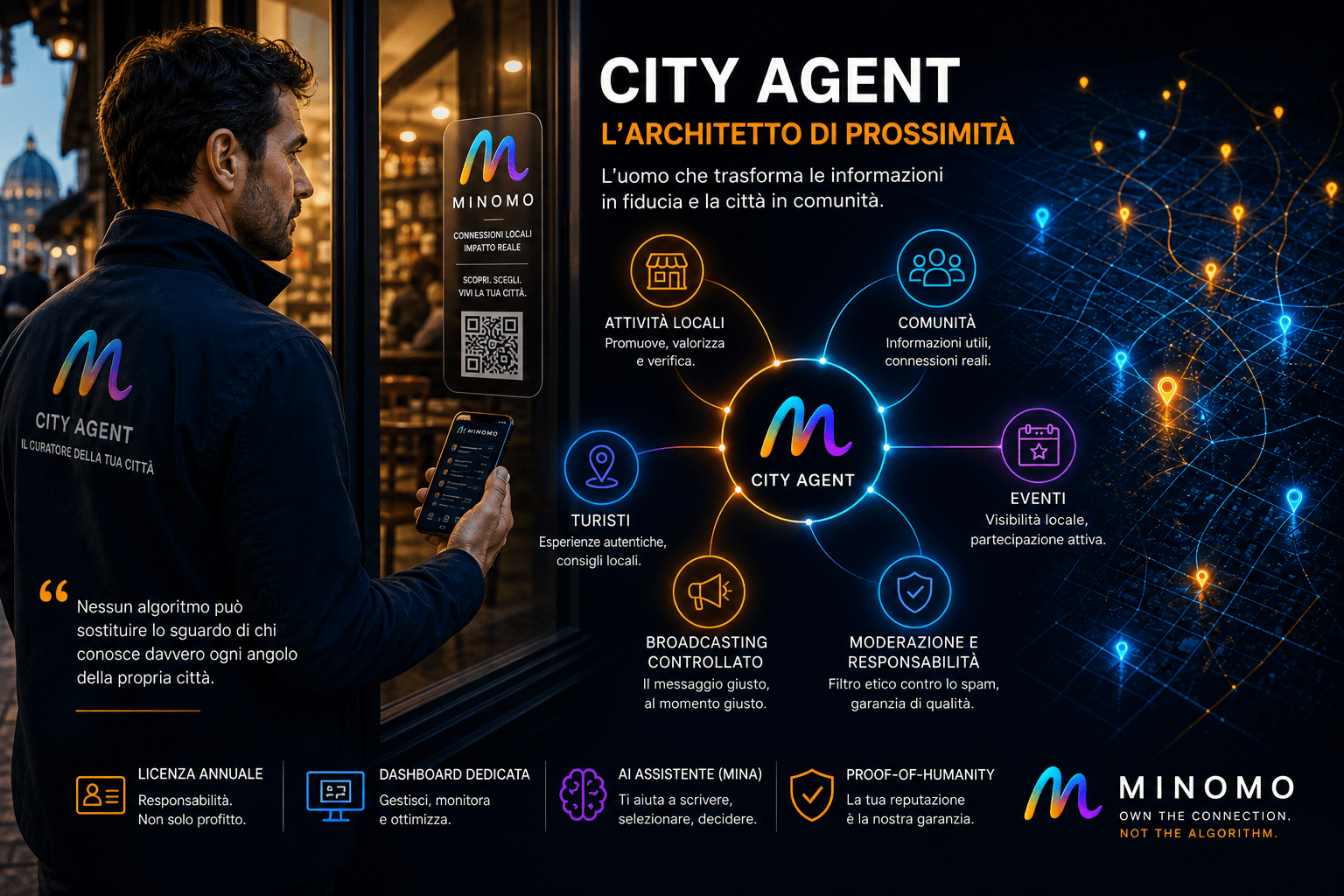
My argument is that MINOMO is not merely launching an app, but recovering an essential social office through the figure of the City Agent. This is not a simple salesperson, but the human synapse that repairs the severed ties of the city, transforming digital rent into living community ownership.
Why the idea of the City Agent works: the nostalgia of the synapse
The term “City Agent” evokes a discreet local authority, almost old-fashioned in a landscape dominated by anonymous interfaces. Psychologically, the idea captures attention because it responds to a chronic fatigue with everything “global”. We are tired of platforms that treat us as statistical units. The City Agent acknowledges that proximity is not just a GPS coordinate, but a relationship of trust. They are the one who gives a face and a name to the digital infrastructure — promising that behind the push notification there is not a bot, but a real local intention.
The existence tax: the real problem they solve
The problem the City Agent addresses with a scalpel is “algorithmic feudalism”. Today, a local business does not control its own audience; it rents it. The City Agent intervenes as a liberator of traffic. They approach cafés, restaurants and institutions not to sell “another app”, but to offer a bypass route. MINOMO short-circuits the large intermediaries, allowing the message to reach the user’s screen directly. The Agent’s role is to explain this “act of independence”: how to go from being a tenant of the feed to being the owner of your own communication.
The contradiction: digital independence through physical presence
There is a fascinating tension in the City Agent’s role: they use the most advanced communication tools — push notifications, integrated ecosystems — to push the user to put down their phone and walk into the shop. The contradiction is that the City Agent “sells” the digital in order to save the physical. It is a paradoxical positioning, but a vital one. We gain digital efficiency, but what is at stake is the recovery of the vitality of the street. If the City Agent succeeds, MINOMO will no longer be seen as an app, but as the “optic nerve” that makes the city visible to itself.
The maturity test: recurring income as a quality guarantee
For the City Agent not to be merely an enthusiast of the moment, MINOMO proposes an economic model based on recurring revenue. This is the real maturity test: the Agent does not pocket a one-off commission and disappear, but is co-invested in the long-term success of the ecosystem. This detail transforms the Agent from contract hunter to community architect. If they do not maintain the relationship — if they do not “curate” the city — their earnings vanish. It is a form of proximity capitalism that imposes quality through financial design.
Italy as a mirror: networking as infrastructure
In Italy, where “knowing the right people” has always been the unofficial currency of society, the role of the City Agent seems almost native. We know instinctively that a direct recommendation is worth more than a banner on a large website. MINOMO formalises this cultural trait. In Italian cities, where small merchants often feel crushed by large chains and advertising costs, the City Agent appears as a “home team” ally. It is the digitalisation of the neighbourhood spirit — a technological adaptation of the idea that “the person makes the place”.
A contrarian thought:
One could object that the City Agent is nothing but yet another intermediary — a new link in an already-too-long chain. Some critics would say that if the technology is sound, it should sell itself without needing a “curator”. Yet reality shows us that pure technology, left to itself, has created only noise and division. The City Agent is not a barrier, but a quality filter. In a world where everyone is shouting digitally, the importance of someone who falls silent and points to what is genuinely relevant becomes a strategic asset.
Conclusion
Ultimately, MINOMO is a “suspiciously” healthy project by the standards of today’s internet. It does not try to keep us trapped in an infinite feed; it tries to re-teach us the way back to the public square. The City Agent is the engine of this vision — a figure who reminds us that, for all our digital sophistication, we need a connection that is human, direct and local. Ironically, we invented the most complex infrastructure in history only to realise that what we truly miss is what our ancestors had in the city squares centuries ago: the ability to speak to each other face to face.