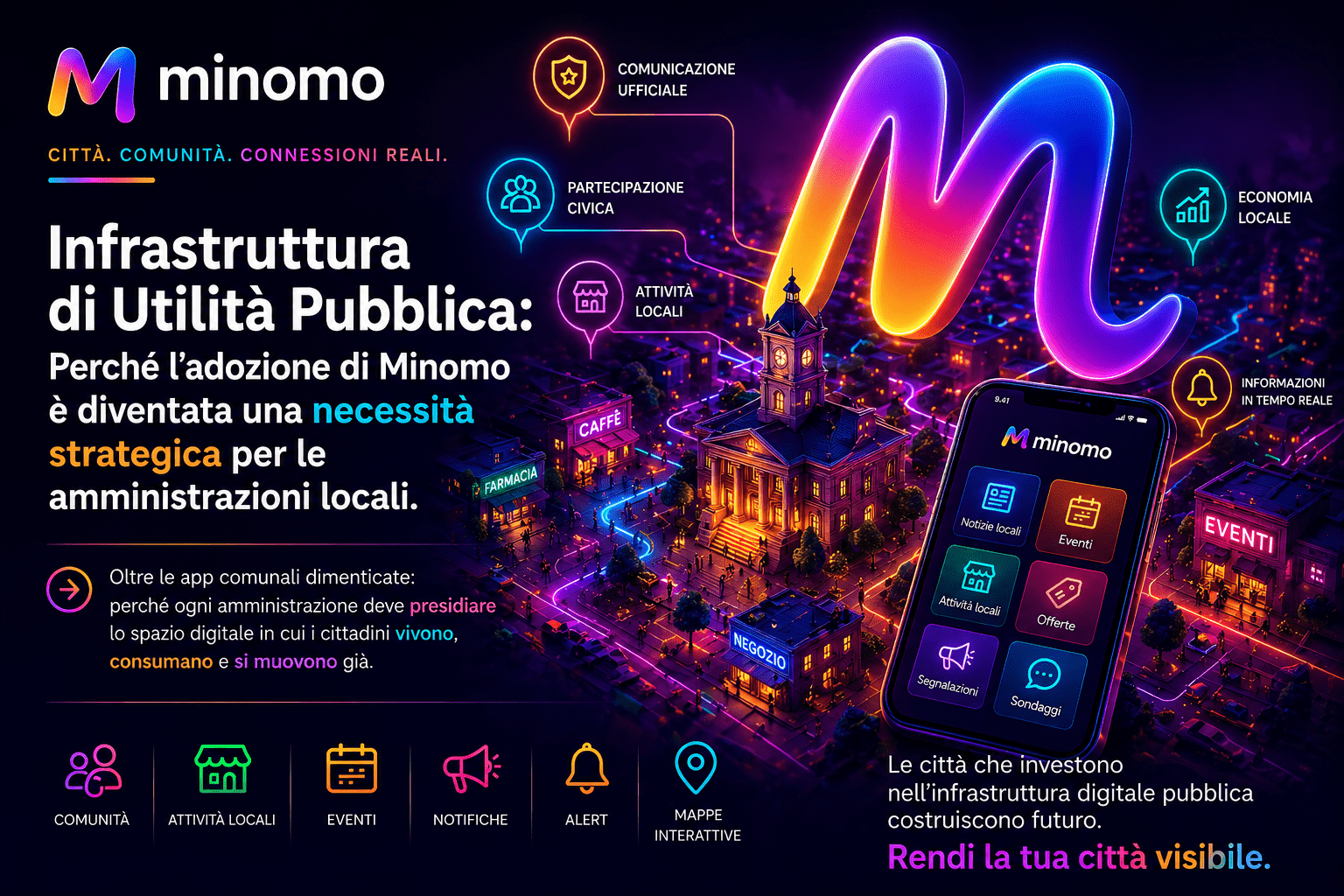
Tuesday morning, ten o’clock. In a provincial Italian city or a neighbourhood buzzing in a metropolis, a silent fracture occurs. A road closes for roadworks, a water main bursts, or a civic museum decides to extend its opening hours. At this moment, the citizen walks in the dark, the tourist consults an outdated map, and the merchant watches an empty shop window. Administrations have tried to repair this tear with “official apps”: expensive digital mausoleums, downloaded once and forgotten immediately, populating the software graveyard on our phones. The problem was never a lack of code, but the absence of a living synapse connecting the institution to the pavement.
My argument is that MINOMO is not an optional add-on, but an indispensable lifeline. MINOMO matters today, in 2026, because it transforms the Smart City from a theoretical concept and a budget sinkhole into a public-utility infrastructure — where the technological cost to the community is zero, but the civic value is vital.
The civic imperative: why the public body must be present
A municipality adopting MINOMO is not a stylistic exercise; it is an act of institutional responsibility. In a world where 90% of our attention is mediated through smartphones, a municipality that does not maintain a presence in the digital ecosystem of its own territory is, in effect, a blind and mute administration.
The strategic necessity of MINOMO rests on three pillars:
- Emergency efficiency: During a weather alert or an evacuation, reaction time is the variable between safety and catastrophe. Having an “institutional” push channel already present on citizens’ phones — because they use it daily for loyalty schemes or tourism — guarantees a reach no municipal website can ever match.
- Fiscal responsibility: Continuing to invest public funds in developing and maintaining proprietary apps destined to fail is economic negligence. MINOMO provides the infrastructure at zero cost, absorbing technical burdens through the merchant market.
- Supporting the local fabric: A public body has a duty to protect its merchants. Integrating with MINOMO means giving institutional dignity to the local directory, turning every shopfront into a point of interest for both residents and visitors.
The broken synapse: the real problem of fragmented information
The problem MINOMO addresses is the atavism of civic communication. Today, to find out why the water is off or where there is a free parking space, you must navigate unofficial WhatsApp groups, rigid institutional websites and notices stuck on doorways. The administration is a “silo” isolated from the economic pulse of the street. MINOMO resolves this urban schizophrenia by unifying the municipality’s voice with the merchant’s shopfront and the tourist guide. For the first time, information about a weather alert and the discovery of an artisan café share the same digital nervous system.
The contradiction: push efficiency vs. citizen silence
Here lies the internal tension: how much “city” can a smartphone take? MINOMO allows up to ten notifications per day. We gain an instant reaction to crises, but we lose the blessed ignorance of the background noise. The platform’s challenge is not to become a digital megaphone constantly shouting from citizens’ pockets. The solution — the City Agent, that human moderation “valve” — is an acknowledgment that no algorithm can distinguish between a civic emergency and advertising spam. The human guarantor ensures the municipality speaks only when it truly has something to say.
Italy as a mirror: between milestones and fibre optic
Italy is the perfect mirror for MINOMO because our cities are a strange hybrid of millennial heritage and cutting-edge technology. We need MINOMO because, while boasting ultra-fast fibre connections, we still learn about a road closure from a notice taped to a lampost. Italy is the place where “the person makes the place” — and the City Agent figure, a real and accountable person who answers for their city, fits perfectly with our atavistic need for a face, not an algorithm, behind institutional information.
A contrarian thought:
Some critics will say that MINOMO is a Trojan horse for the privatisation of public information space. “If it’s free for the municipality, who is really the product?”, the cynics will ask. It is a legitimate concern — but it misses the point. The administration does not surrender data; it gains access to an audience it was unable to aggregate itself. MINOMO does not sell the citizen’s profile, but their geographic context. In 2026, refusing infrastructure of this kind out of ideological purism means condemning the citizen to an urban blindness that costs far more than any push notification.
Conclusion
Ultimately, the city is not a collection of buildings but a continuous flow of events, needs and encounters. MINOMO is the recognition that the “Smart City” is not the one choked with useless sensors, but the one where the citizen knows, in real time, that their road is closed, that the museum is open and that the bakery on the corner has fresh bread. With MINOMO we have domesticated technology to serve the public square once more, restoring to us the right to no longer be strangers in our own neighbourhood. The time for asking whether to adopt it is over. The only question left is how we managed without it for so long.