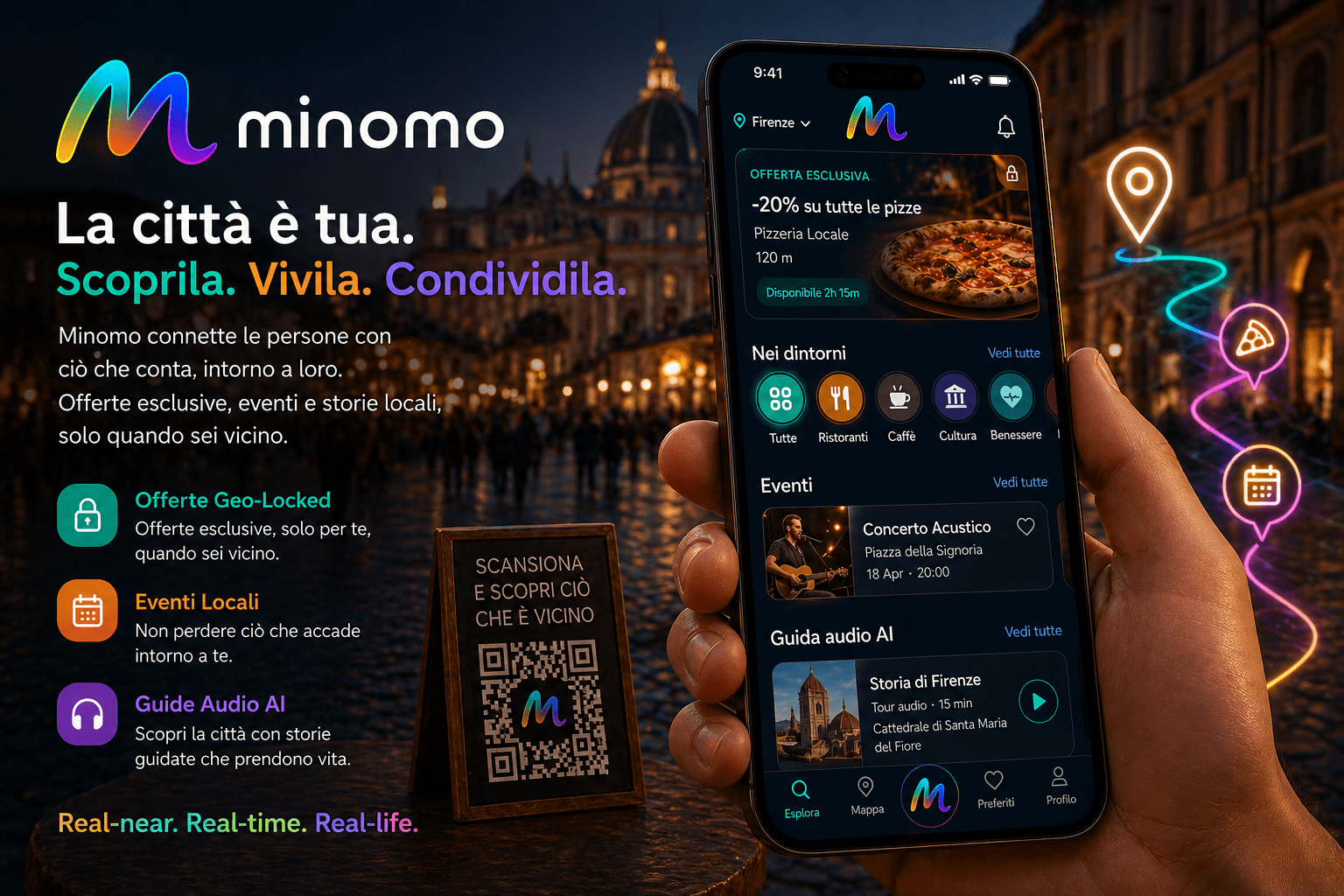
A March evening in Rome, Milan, or perhaps the historic centre of Bologna. The owner of a small artisan pizzeria watches, through a fogged-up window, the street he has occupied for a decade. He knows that, at this precise moment, thousands of potential customers are less than five hundred metres away. And yet, between his lit oven and their glowing screens, there yawns an invisible abyss, patrolled by opaque algorithms. For him to tell them the bread is warm, he must pay a tribute to an overseas giant that decides his visibility according to rules nobody truly understands. This toll-gate of proximity has transformed the city from a space of encounter into an inventory of rented audiences.
MINOMO seems to have grasped that the real stakes in 2026 are no longer technological, but a recalibration of local sovereignty. In my working hypothesis, MINOMO is not a simple marketing app but an infrastructure of digital secession — one that attempts to short-circuit algorithmic feudalism in favour of an economy of physical presence.
Why the name MINOMO works: minimalism, monocle or moment?
The name has a peculiar, almost onomatopoeic quality — it evokes the beat of an urban heart. In a world of verb-names (Uber, Google, Zoom), MINOMO sounds like a static noun, a place. Psychologically, it seems to invoke the moment and the micro-community. It is a minimalist linguistic barrier that refuses the aggressive jargon of tech brokers. There is an aesthetic of silence in this choice that contrasts with the deafening noise of pointless notifications. MINOMO suggests that the city should not be optimised to the point of sterilisation, but inhabited with a finer, almost surgical attention.
The rent on your own doorstep: the real problem
The real problem MINOMO puts on the table is the algorithm tax. We have reached the absurd point where a merchant pays rent twice: once to the physical owner of the walls, and a second time to the owner of the digital platform that permits them to appear on their neighbours’ phones. This double taxation of proximity kills urban authenticity. MINOMO strikes the right chord — economic independence. By proposing a direct channel, it offers not merely a sales tool, but a key to the city that no longer needs to be borrowed from Menlo Park or Mountain View.
The contradiction: the cultivated tension of control
Every attempt to liberate local communication carries an internal tension. On one side, we gain the sovereignty of the direct relationship — the pizzaiolo presses a button and the restaurant fills up. On the other, we risk turning the city into a relentless echo of solicitations, if no filter exists. Here the real challenge emerges: can a digital system imitate the common sense of a neighbour? The contradiction between the speed of a push notification and the slowness required for an authentic urban experience is the thread MINOMO must follow without losing itself in the labyrinth of well-intentioned spam.
The maturity test: beyond the installation hype
For MINOMO not to remain a footnote in the history of trend apps, it must demonstrate the capacity to generate long-term behaviour change. The maturity test lies not in the number of downloads, but in the ability to generate loyalty without friction. People do not want more apps; they want solutions that disappear into the background when not needed. If MINOMO becomes a noisy presence, it will be deleted. If it becomes the invisible optic nerve of the city — one that activates only when you pass a bakery with warm croissants — then it will have succeeded in weaving the digital into the fabric of reality.
Italy as a mirror: where everything becomes clearest
Italy is the ideal laboratory for an initiative of this kind, for reasons embedded in our social DNA. We are the culture of the piazza, of neighbourhood sociality, and of the survival spirit of the local shop. In Italian cities, the square is still a vibrant concept, not merely a transit space. Here, distrust of large institutions and global platforms is doubled by a visceral trust in the person on the corner. MINOMO finds in Italy a faithful mirror because we, more than other nations, know that a real connection is worth more than a million paid likes.
A contrarian thought:
One could object that MINOMO does nothing but add yet another layer of digital mediation to an already oversaturated world. Some critics would say that reconquering the square means leaving the phone in your pocket, not using it as a metal detector for offers. Yet ignoring the digital in 2026 is an act of romantic self-destruction. The answer is not the abandonment of technology, but its domestication. MINOMO does not seem to want to force us to stare at screens, but to use the screen as a compass that points the way back to reality.
Conclusion
Ultimately, the city is an infinite conversation between people, walls and needs. MINOMO has the ambition to be the microphone — not the censor — of that conversation. Its success will be measured in occupied tables, in historic monuments that regain a voice through AI guides, and in the sense that, finally, the owner of the artisan pizzeria on the corner holds the keys to their own visibility. The smart city is not the one crammed with sensors, but the one where the citizen does not feel a stranger in their own neighbourhood.
We may be looking, for the first time, at a tool that does not sell us the city, but gives it back.